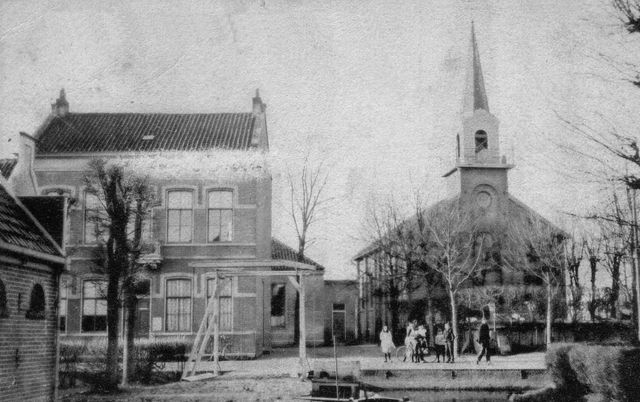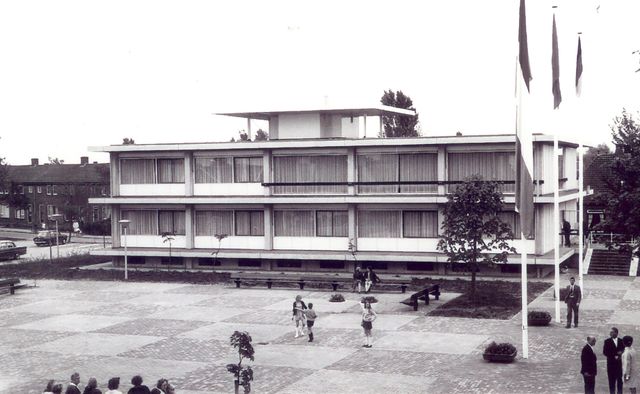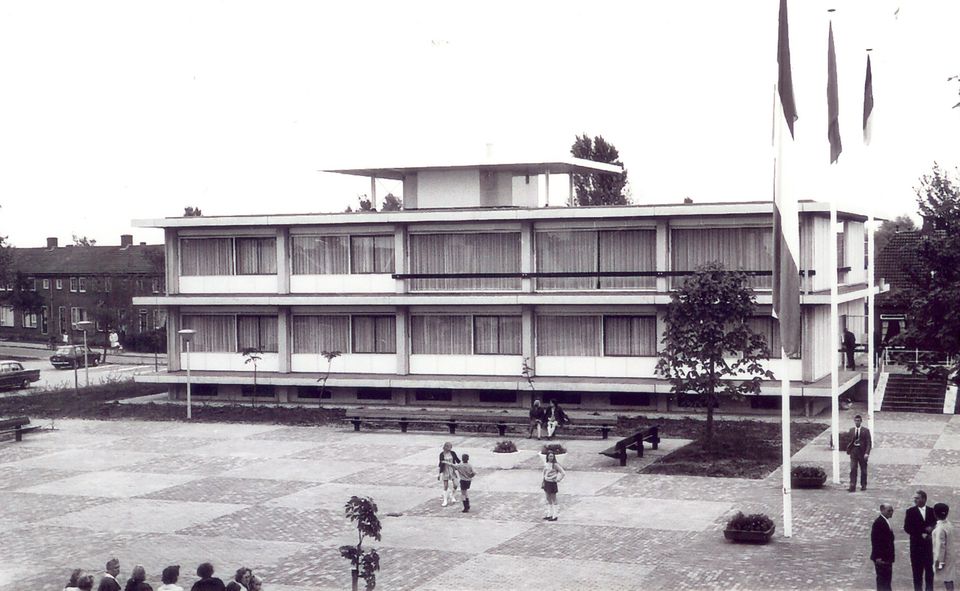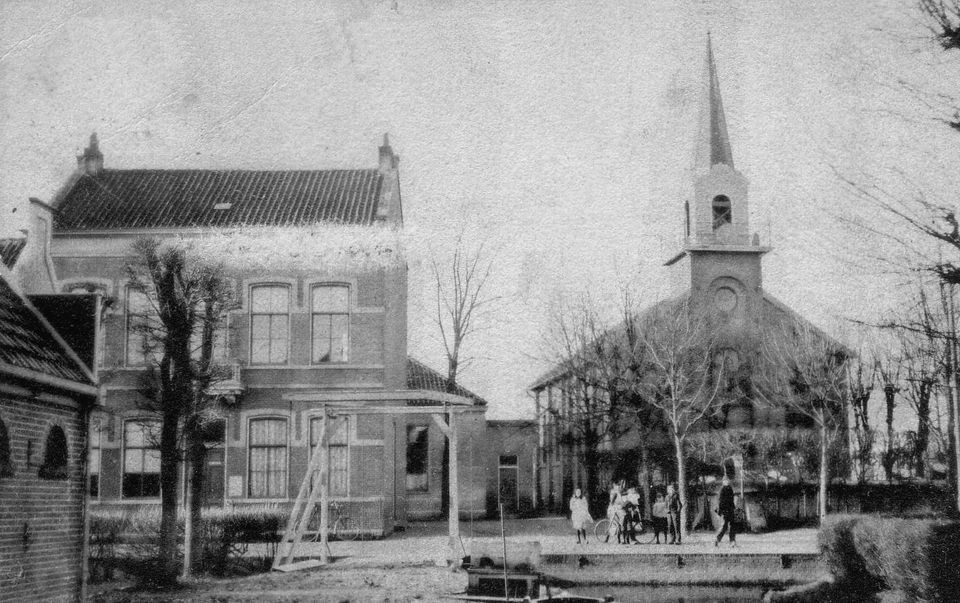
The old vicarage and town hall
On 2 August 1497, Pieter Witken Jacobszoon transferred a simple farmstead to the church wardens of Landsmeer.
Its location was described as ‘opposite the church on the east side of the Gouw or Wegsloot’ – the spot where the town hall now stands. The farmstead was elevated to the status of a vicarage and inhabited by various vicars.
As a result of the Reformation and Alteration, Catholicism in the northern Netherlands was replaced by Protestantism in the 16th century. That this was also the case in Landsmeer is evident from the magnificent ‘pastors’ plaques’ in the Reformed Church on Dorpsstraat. The village’s first minister, Rev. Houtmannes, moved into the vicarage in 1596; his successors also lived there.
The structural condition of the little building was in…
Its location was described as ‘opposite the church on the east side of the Gouw or Wegsloot’ – the spot where the town hall now stands. The farmstead was elevated to the status of a vicarage and inhabited by various vicars.
As a result of the Reformation and Alteration, Catholicism in the northern Netherlands was replaced by Protestantism in the 16th century. That this was also the case in Landsmeer is evident from the magnificent ‘pastors’ plaques’ in the Reformed Church on Dorpsstraat. The village’s first minister, Rev. Houtmannes, moved into the vicarage in 1596; his successors also lived there.
By this time, the building was in such a poor state of repair that it was decided in 1647 to build a new vicarage. This, too, was occupied by numerous ministers, the last of whom was Rev. Prins in 1807–1808. The property subsequently passed into the ownership of, in turn, Jan Kalf, Simon Jansz. Goede and Petrus Annaeus Amelander. The next owner, Neeltje Berg, who ran a small shop on the premises, transferred the house to her son-in-law Jacob Brandjes in 1838.
The Brandjes family, who played an important role in Landsmeer, owned the house for over eighty years. The last member of the Brandjes family to live there was Jacob’s grandson Willem, a keen amateur photographer. Much of his work can be found in the archives of the Landsmeer Antiquarian Society. The photographs provide a good insight into Landsmeer in the early 20th century.
Piet Evers bought the house in 1921. The building’s structural condition required constant attention. For instance, in the early 1940s, the stone south wall was replaced with a wooden one, as the house had begun to subside and wood is lighter than stone. In 1951, however, the building – by then known as the Papenhuis – was demolished by its new owner, the municipality of Landsmeer. Given its heritage value, this was carried out with care, so that reconstruction might be possible. This took place two years later at the Arnhem Open-Air Museum. In January 1970, however, the Papenhuis was one of five buildings destroyed by fire.
As mentioned, the town hall, built in 1969, now stands on the site in Landsmeer where the Papenhuis once stood.
Opposite it stands the former town hall, dating from 1870.