
Three mill strakes and a sloping ditch | Beemster Mills
Contact
1464 PC Westbeemster Plan your route to Drie molengangen en een schuine sloot | Beemster Molens
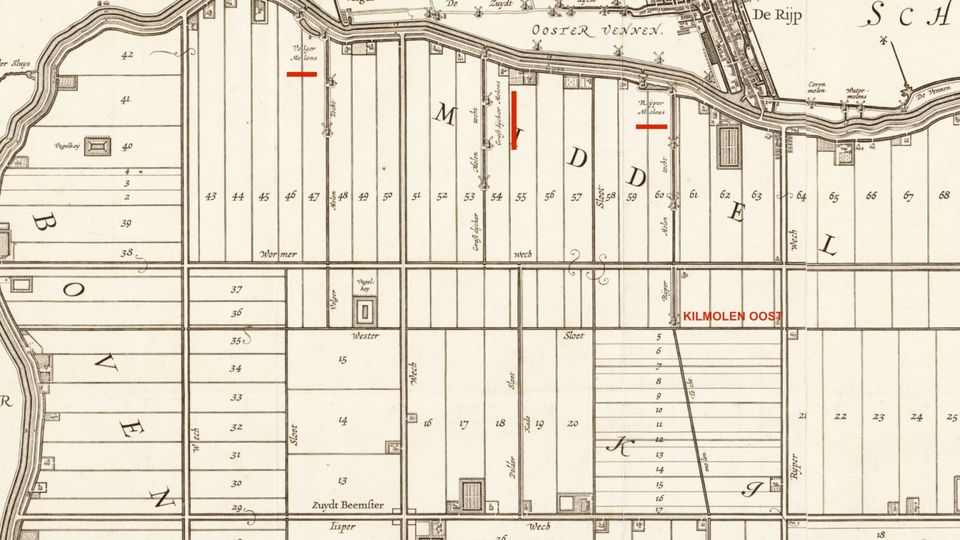
Volger or Spijkerboorder mill corridor
Mills were the LEGO 'avant la lettre'. Building kits, you could quickly tear them down and rebuild them elsewhere. Consequently, when the Beemster was reclaimed, the mills were moved several times because drainage required it. The wide green path by the fence between the fort at Spijkerboor and Westdijk no 45 is still a remnant of this mill corridor.
Grafterdijker and Rijper mill corridor
These two mill corridors stood a short distance apart. Farm de Molenkolk, near Westdijk no 38, stands where the Graftdijker mill corridor once stood.
The sloping ditch and kilmill
The Rijper mill corridor, at Westdijk no. 34, concerned...
Mills were the LEGO 'avant la lettre'. Building kits, you could quickly tear them down and rebuild them elsewhere. Consequently, when the Beemster was reclaimed, the mills were moved several times because drainage required it. The wide green path by the fence between the fort at Spijkerboor and Westdijk no 45 is still a remnant of this mill corridor.
Grafterdijker and Rijper mill corridor
These two mill corridors stood a short distance apart. Farm de Molenkolk, near Westdijk no 38, stands where the Graftdijker mill corridor once stood.
The sloping ditch and kilmill
De Rijper molengang, near Westdijk no. 34, caused the dykes quite a few headaches. Water management did not work well here. The middle of the Beemster was extra deep and the mill stood along a block of small north-south running plots. The water here had to make several right angles to reach the mill which did not work well. A sloping ditch was dug through these plots so that water drainage improved. A small mill from the Spijkerboordergang was moved here. You can still see the watercourses of the Rijper molengang in the landscape.
The bridge at De Rijp
When the Beemster Lake was drained, the Rijpers were deprived of their livelihood: fishing. Early on in the reclamation they demanded a bridge, but det lasted until April 1615. Even the high visitors with the princes had to enter the Beemster over a makeshift construction.
Leeghwater writes:
"The Heeren Hoofdingelanden invited Prince Maurits and his brother to a banquet in the Beemster to view the successful embankment. The roads in the new polder were reasonably passable and, on 4 July 1612, Princes Maurice and Frederik Hendrik visited. The party had arrived in De Rijp a day before, where they were welcomed by Jan Sijpersz. who had a beautiful young lady (a pretty spinster) with him. He gave both princes a gold coin.
As there was not yet a bridge across the ring ditch at De Rijp , skipper Jan IJsbrands arranged for a 'bridge' to be built. With barges, prams and planks, he ensured a crossing with dry feet for the princes and their company."