
Waders
The name actually says it all, waders are birds with long, thin legs, often paired with a long, thin beak.
This makes these birds ideally suited to swampy moorland landscapes, where they can root deep into the ground with their long beaks. These are the birds that many people consider the typical meadow birds. Can you find them all?
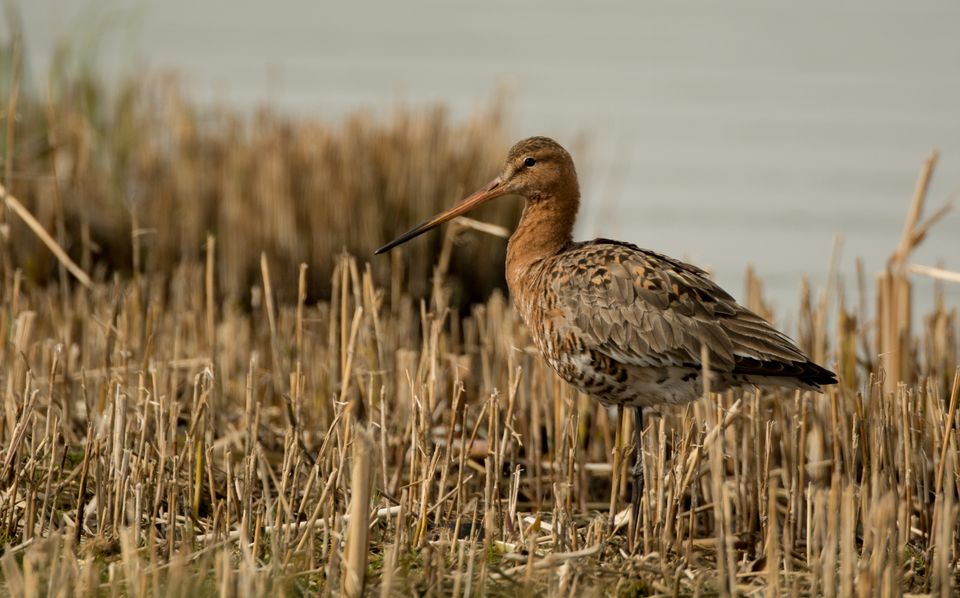
Black-tailed godwit
The black-tailed godwit is truly an archetypal Dutch meadow bird. It was even voted the national bird of the Netherlands in 2015! It is indispensable, with its tall, slender legs and long, pointed beak. The name godwit comes from its call; a loud and clear 'gruttooo, gruttooo'. The bird is brown in colour, with a white belly. The male...
This makes these birds ideally suited to swampy moorland landscapes, where they can root deep into the ground with their long beaks. These are the birds that many people consider the typical meadow birds. Can you find them all?
Black-tailed godwit
The black-tailed godwit is truly an archetypal Dutch meadow bird. It was even voted the national bird of the Netherlands in 2015! It is indispensable, with its tall, slender legs and long, pointed beak. The name godwit comes from its call; a loud and clear 'gruttooo, gruttooo'. The bird is brown in colour, with a white belly. The male has a brick red colour on his neck and head. The black-tailed godwit is often seen flying, in the breeding season during courtship flights or to protect their young from birds of prey. If you look closely, you will see its belly with black and white bands, the thick white wing stripe and the legs sticking out at the back. The black-tailed godwit is best seen between February and July/August.
Oystercatcher
Oystercatchers are black and white birds on high legs. They are best recognised by their bright orange bill. This beak is quite special, as it changes shape! In summer, it is more pointed, so the oystercatcher can easily poke around in the ground for worms and other food. In winter, when the oystercatchers leave for the Wadden and Delta regions, the beak becomes blunter. This allows them to use the bill as a chisel, to break open cockles and other shellfish. Flying, the oystercatcher can also be recognised by its black and white tail and the white stripe across its wings. Or do you hear it shrill "(to-)piet!"?
Turtle
The redshank, with its long, red-orange legs, can be recognised from a distance. It is also easy to spot by the broad, white trailing edge of its wings and the orange bill attachment. The name redshank also comes to this bird from its singing sound: "tjululuu". The numbers of redshanks have declined sharply in recent years in the Netherlands. This bird is also on the red list of Dutch breeding birds. Nevertheless, they can still be seen occasionally in Waterland. Some redshanks stay in the country all winter, but most prefer to migrate to warmer places. The best time to see these creatures is between March/April and September.
Kievit
The lapwing is a recognisable bird. With its distinctive crest, black and white plumage and broad wings, it cannot be missed. Lapwing males make spectacular tumbling movements in the air and a recognisable sound during courtship - this is what gives the bird its name. The lapwing can sometimes be found in the Netherlands in winter, but if it freezes too badly they leave for England and France. You'll find them here mainly between March and October.
Snipe
Some people may remember the snipe as the bird that appeared on the 100 guilder note for a while. It is easily recognised by its long, pointed bill and distinctive brown and white stripes on its head. The snipe is a fairly rare meadow bird, which is also well sheltered by its colours. It is more recognisable in the sky, where when disturbed it zigzags upwards with a hoarse 'skrètsj...skrètsj...' call. Its courtship flight is also striking, where it dives down at an oblique angle. Snipes arrive in the Netherlands from March to May, and leave again immediately after breeding, until deep into the winter.
Kestrel
Unfortunately, the ruff is no longer found in Waterland. With the measures that are now being taken to make the meadow birds happy here, the hope is that the ruff will eventually find its way back to Waterland. This meadow bird is very special indeed. In spring, impressing the females is a true spectacle. The males then display a beautiful plumage and hold sham fights on tournament fields. Hopefully we will be able to witness this game again in Waterland in the future.