
Purmerends Museum & Zuiddijk | Beemster Mills
Contact
1441 BH Purmerend Plan your route to Purmerends Museum & Zuiddijk | Beemster Windmills
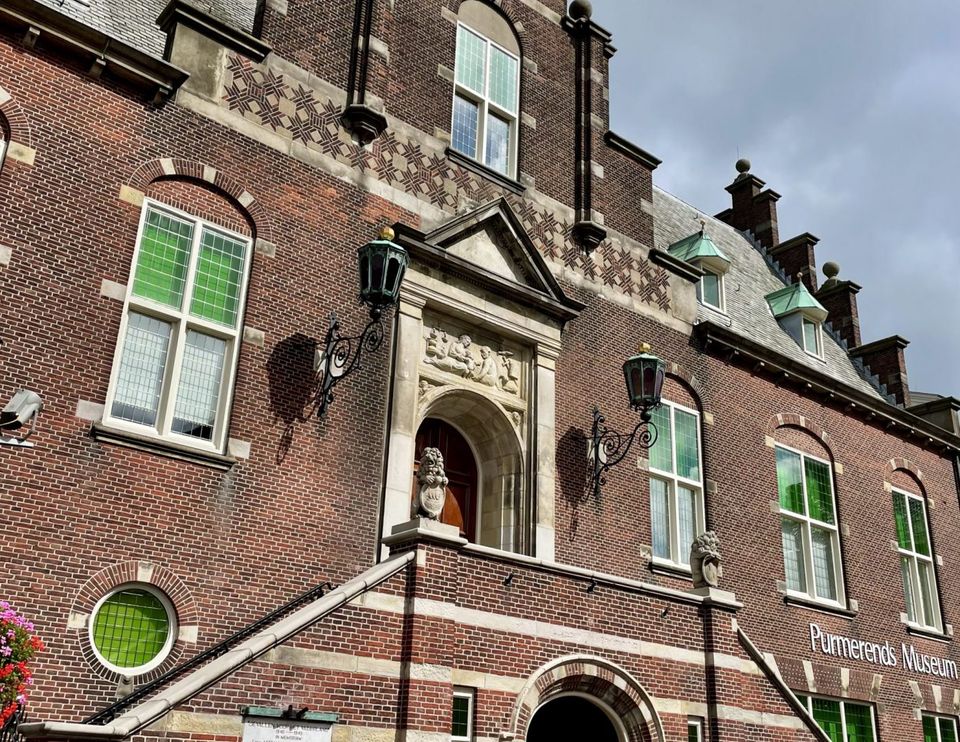
Here you will find lots of information about the history of Purmerend: about the castle, the consequences of the draining of the Beemster, Purmer and Wormer, the development from fishing village to market town.
You will find early works by some Purmerend-born architects such as J.J.P. Oud, Mart Stam and Jac. Jongert. The museum has a fine collection of Purmerend earthenware from the period 1896-1907 from the factories Wed. N.S.A. Brantjes & Co, NV Haga, L. Huisenga and Jb Vet & Co.
Curious? Take a digital look around the museum, where you will also find the tourist information office.
Continue your route on the Zuiddijk by the Beemster Bridge.
Contracting out dyke work and fishing licences
Through posters setting out the conditions for the work, the Hoofdingelanden sought workers for the dyke section to be built near Purmerend. Leeghwater writes:'On 10 April 1608, under gro...
You’ll find early works by several architects born in Purmerend, such as J.J.P. Oud, Mart Stam and Jac. Jongert. The museum has a fine collection of Purmerend pottery from the period 1896–1907, produced by the factories Wed. N.S.A. Brantjes & Co, NV Haga, L. Huisenga and Jb Vet & Co.
Curious? Take a virtual tour of the museum. The museum shop also houses the tourist information centre, where staff will be happy to provide you with further information.
Continue your route along the Zuiddijk at the Beemsterbrug.
Tender for dyke works and fishing licences
Through posters setting out the conditions for the work, the Hoofdingelanden are seeking labourers for the section of dyke to be constructed near Purmerend. Leeghwater writes:‘On 10 April 1608, amidst great public interest at the Castle, the contract for the dyke section was awarded to Jan Adriaansz Jongkind van Burghorn. As he had been the first to mine the first section, he was rewarded with a barrel of beer.’
Following the reclamation, the fishermen had lost much of their fishing grounds and the open waterways had fallen into disrepair. This hampered shipping. Surrounding villages requested permission to fish in the ring canal. In 1656, the town of Purmerend and the Hoofdingelanden of Beemster reached an agreement regarding fishing in the ring canal between Draaioord and the southern end of the Wormerweg. This was permitted subject to strict conditions. For instance, fishermen were not allowed to damage the ring dyke, obstruct water discharge or hinder shipping, all on pain of a fine.
Zuidijk at No. 14
There is a large floodgate in the Zuiddijk. This forms part of the UNESCO World Heritage Site ‘The Dutch Waterlines’ and was constructed between 1890 and 1891. The floodgate was used for ‘flooding the Beemster’. More information can be found on the sign, and you can walk down to the sluice chamber. Please note: close the gate, as there may be sheep in the area.
Zuiddijk at no. 13
This is one of the loading points at the loading sites along the ring canal where, amongst other things, livestock was loaded onto boats for transport to the market. This place is therefore called ‘de Dood’ (the Death), as the livestock was usually taken away for slaughter. The farm across the way also bears this name.
Zuiddijk 13
This is where the Fort on Middenweg is situated, part of the UNESCO World Heritage Site ‘The Dutch Waterlines’. Unfortunately, you cannot visit it. However, the fort and its moat are clearly visible from the dyke.