
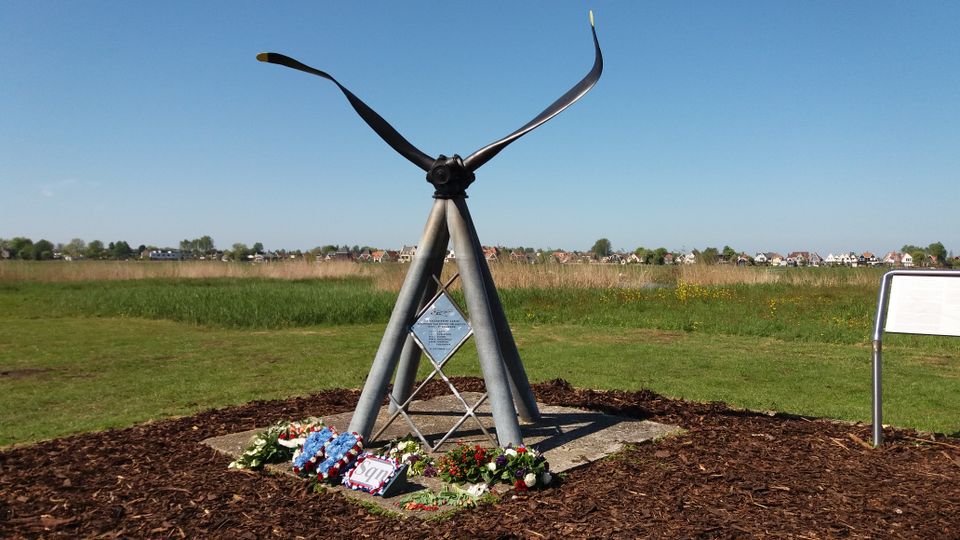
Vickers-Wellington Monument
The war memorial in Landsmeer is composed of two propeller blades from a crashed aircraft, attached to a four-armed steel structure. A plaque on the structure bears the following text:
IN MEMORY OF THE
CREW OF VICKERS WELLINGTON
T2879, 99 SQUADRON
J.S. PARRY
I.J. ROBERTSON
W.R.J. BROWN
H.MCL. MACDONALD
A.W.M. CHAPMAN
E. FIELDHOUSE
29 SEPTEMBER 1941
The History
On the night of 28–29 September 1941, a Royal Air Force (RAF) air fleet bombed the northern Italian port city of Genoa. Of the 41 aircraft taking part in this raid, eight Wellichting MK. 1C bombers from 993 Squadron were also involved. Genoa was actually beyond the bombers’ range. They were therefore fitted with long-range fuel tanks suspended in the bomb bay. The number of bombs was reduced to just two 500-pound bombs and nine 50-pound bombs.
The Wellingtons struggled to climb …
IN MEMORY OF THE
CREW OF VICKERS WELLINGTON
T2879, 99 SQUADRON
J.S. PARRY
I.J. ROBERTSON
W.R.J. BROWN
H.MCL. MACDONALD
A.W.M. CHAPMAN
E. FIELDHOUSE
29 SEPTEMBER 1941
The History
On the night of 28–29 September 1941, a Royal Air Force (RAF) air fleet bombed the northern Italian port city of Genoa. Of the 41 aircraft taking part in this raid, eight Wellichting MK. 1C bombers from 993 Squadron were also involved. Genoa was actually beyond the bombers’ range. They were therefore fitted with long-range fuel tanks suspended in the bomb bay. The number of bombs was reduced to just two 500-pound bombs and nine 50-pound bombs.
The Wellingtons struggled to climb to their maximum altitude in order to fly over the Alps. Once above their target, they dropped their bombs. Virtually no anti-aircraft fire was observed there. The few shells that were fired missed their target. After the attack, one of the Wellingtons, the LN-C flown by Sergeant Joseph Stewart Parry, did not return to its home base at Waterbeach in England. Radio signals from the bomber had been received for about ten hours during the return flight. The crew were reported missing. According to Bomber Command’s Operational Record Book, the attack was a success. But was this really the case?
Three Wellingtons crashed and two others went missing. One of those missing bombers was the Wellington Mk IC (LN-C) with serial number T2879. The aircraft had taken off at 7.20 pm with six crew members on board: one Canadian, two New Zealanders, one Australian and two Englishmen.
The crew probably thought they were flying safely over England, something they were unable to verify due to the thick ground fog or low-hanging cloud below them. Unfortunately, the Wellington LN-C was flying over the North Sea when the crew members bailed out of the bomber on the captain’s orders. Bad weather during the return flight had ‘blown’ the aircraft off course to the east. All crew members ended up in the sea and drowned. Of the six crew members, Sergeant Ian James Robertson, the co-pilot, and Sergeant Hugh McLennan MacDonald, the radio operator, washed ashore on the beach at Texel. They are buried in the cemetery at Den Burg. The observer, William Raymond James Brown, washed ashore at Harlingen, where he was buried. The remaining three crew members – Sergeant Edward Fieldhouse, gunner; Sergeant Joseph Stewart Parry, pilot; and Sergeant Alfred William Musgrave Chapman, telegraph operator/gunner – are still missing to this day.
After the crew members had bailed out, the Wellington LN-C continued its flight unmanned. The aircraft made a turn and flew via IJmuiden towards Amsterdam. Under fire from anti-aircraft guns and running low on fuel, the aircraft crashed with a tremendous crash at 07.42 on 29 September 1941 in the remote Landsmeerderveld, just north of Amsterdam. Shortly before this, it had been attacked by a German fighter. Many local residents from Landsmeer witnessed the incident. A German outpost at Schellingwoude also reported the Wellington’s crash. The Germans made a further attempt to recover the aircraft. However, the wreckage had sunk too far into the marshy pasture. Subsequent attempts, such as the one in 1976, also failed, until the wreck was finally recovered in the spring of 1995 under gruelling conditions.
Exactly 56 years later, the monument in the Landsmeerderveld was unveiled. It was erected there on the initiative of the ARG ’40-45’ Foundation from Assendelft and the ‘Berging Vickers Wellington’ working group. It was designed by Arjan Kuiper and Suzan Wensink from Landsmeer. They used the propeller blades of the T2879 as a symbol of victory. The propeller stands on a frame that replicates the geodesic structure of the linen-covered Wellington.