
Ducks
We all know the mallard duck from ditches, parks and ponds in your neighbourhood. But many other unusual duck species live in the Netherlands.
Some ducks, like the tufted duck or teal, are even considered primary pasture birds because they breed mainly on grasslands. Will you find them all on your bike ride?
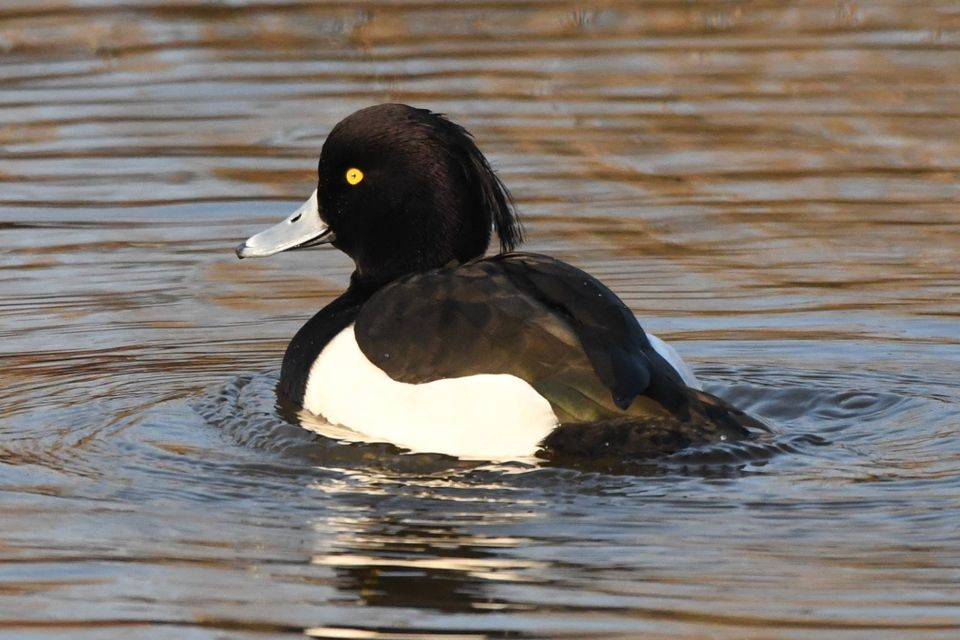
Tufted Duck
If you see this species of duck, you will immediately understand its name! These birds have a characteristic crest on their rear head....
Some ducks, like the tufted duck or teal, are even considered primary pasture birds because they breed mainly on grasslands. Will you find them all on your bike ride?
Tufted Duck
When you see this species of duck, you understand the name right away! These birds have a characteristic crest on the back of their heads. The crest of the brown-coloured females is shorter than that of the black and white males. Also striking are the bright yellow eyes of these ducks. When they extend their wings, you can see the white stripe that runs across the flight feathers. These ducks can also be recognised by their sound: Males make high-pitched whistling, gurgling and trilling sounds while courting. Females make a low "raah-raah". The tufted ducks you find in the Netherlands in winter have come over from central and northern Europe. The crested ducks that do migrate to warmer places leave around September and return around April.
Gadwall
The gadwall already looks more like the duck we know from cities, parks and ditches. This is not surprising, as the gadwall is closely related to this wild duck. The females, in particular, closely resemble the mallard duck females. Yet there are a few points to distinguish them: the white transom, the white belly and the orange bill. Males have a brown head and a black abdomen with a light brown tail tip, otherwise they are grey with fine markings. The shoulder feathers are remarkably long and it has a grey-black bill. Male squat ducks make high-pitched feep sounds during courtship, alternating with a dry "è". Females make snatches. In winter, gadwall migrate south.
Shoveler duck
You may not easily come across the Shoveler in Waterland. Since the 1960s its numbers have declined significantly, seriously enough to end up on the red list of breeding birds. But they are still around, and when you spot them, they are beautiful to behold! Males have a bright green head, white breast and chestnut-brown belly and flanks. If you see them flying, you may be able to see the light blue inside of the forewing. Also characteristic is the broad, flat, spatula-shaped beak with which the Shoveler efficiently slobbers duckweed and aquatic animals. Male shovelers make a strange, low guttural sound, but females have a distinctive double croak. The shoveler arrives in the Netherlands from March and leaves again between September and October.
Garganey
The garganey is also a vulnerable species in the Netherlands. Its numbers have declined by as much as 90% since the 1950s. This puts the garganey on the red list of endangered bird species. Males have a purple-brown head with a distinctive white bow running from their eye across their neck. The breast is brown with an unusual pattern, the flanks are finely grey banded and the shoulder feathers are black and white with some blue. The male has a distinctive dry, short, croaky call, a little frog-like. Female has a high-pitched croak. The summer teal can be found between March/April and July in the Netherlands.